This international conference aims to create a space for discussion on current challenges in the field of language education. We have chosen to define language in its broadest sense, as a dynamic and vital manifestation of human communication that connects us as individuals and communities. This social dimension of language resonates with the positioning of social actors as envisioned by the Council of Europe, which states that "the user/learner as a social actor co-constructs meaning in interaction, and through the development of notions of mediation and plurilingual and pluricultural competences" (Council of Europe, 2021, p.21). Highlighted also by the works led in sociolinguistics (Cuq & Gruca, 2017), the concept of language offers a broader social aspect as "the part of linguistics that deals with the relationships between languages and their speakers" (ibid, p.72). Thus, its teaching is not solely limited to the transmission of linguistic knowledge but also integrates an intercultural dimension essential for understanding and interacting in multilingual environments (Byram, 2009).
The central theme of this conference is to rethink language education, moving beyond the traditional view of language as a system to be mastered, towards a vision of language as a powerful tool for mediation, interaction, and human connection. This choice invites researchers and practitioners to present and explore innovative and multidisciplinary pedagogies that reflect the complexity of communication in our modern societies, where plurilingual social actors interact.
This multilingual event, held in French, English, Chinese, and Arabic, celebrates the richness of all languages and affirms the value of linguistic plurality in the field of education. It is precisely this plurality that the conference seeks to embrace and promote. Indeed, with the current evolution of the world, plurilingualism has become part of individuals' identities. As Françoise Hickel (2007) reports regarding Danièle Moore's book, Plurilinguismes et école, “the repertoire is complex, plural, and dynamic. Language and culture contacts, as well as forms of alternation can serve as resources, from which the potential for learning can be harnessed [...]”. Therefore, it seems necessary for language teaching to take into account and build upon learners' plurilingual repertoires.
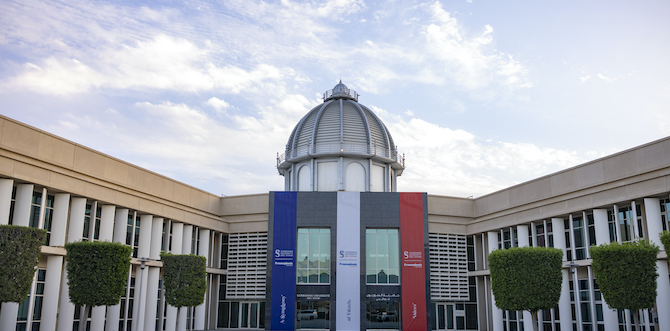
This event will take place at Sorbonne University Abu Dhabi, whose motto, "a bridge between civilisations," fully aligns with the philosophy of this scientific event, affirming the desire to create connections between languages. This location provides a conducive environment for encouraging deep, open, and critical reflection on the challenges of language teaching in Arabic-speaking context.
The conference will be structured around three main symposiums:
Symposium 1: Cross-curricular and plurilingualism
Symposium 2: Curriculum Design and development
Symposium 3: Teaching experiences, pedagogy and practices
 Loading...