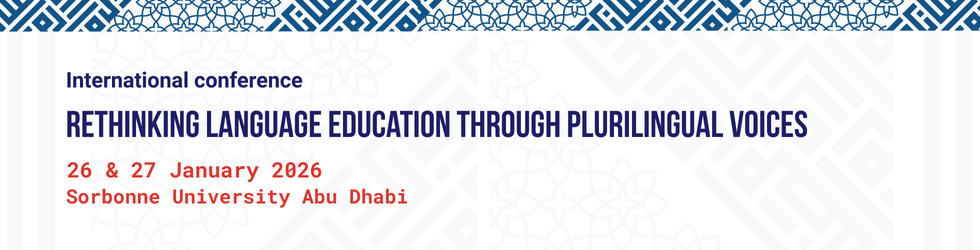
Call for papersThis international conference aims at creating a space for discussion on current challenges in the field of language education. We have chosen to define language in its broadest sense, as a dynamic and vital manifestation of human communication that connects us as individuals and communities. This social dimension of language resonates with the positioning of social actors as envisioned by the Council of Europe, which states that "the user/learner as a social actor co-constructs meaning in interaction, and through the development of notions of mediation and plurilingual and pluricultural competences" (Council of Europe, 2021, p.21). Highlighted also by the worksled in sociolinguistics (Cuq & Gruca, 2017), the concept of language offers a broader social aspect as "the part of linguistics that deals with the relationships between languages and their speakers" (ibid, p.72). Thus, its teaching is not solely limited to the transmission of linguistic knowledge but also integrates an intercultural dimension essential for understanding and interacting in multilingual environments (Byram, 2009). The central theme of this conference is to rethink language education, moving beyond the traditional view of language as a system to be mastered, towards a vision of language as a powerful tool for mediation, interaction, and human connection. This choice invites researchers and practitioners to present and explore innovative and multidisciplinary pedagogies that reflect the complexity of communication in our modern societies, where plurilingual social actors interact. This multilingual event, held in French, English, Chinese, and Arabic, celebrates the richness of all languages and affirms the value of linguistic plurality in the field of education. It is precisely this plurality that the conference seeks to embrace and promote. Indeed, with the current evolution of the world, plurilingualism has become part of individuals' identities. As Françoise Hickel (2007) reports regarding Danièle Moore's book, Plurilinguismes et école, “the repertoire is complex, plural, and dynamic. Language and culture contacts, as well as forms of alternation can serve as resources, from which the potential for learning can be harnessed [...]”. Therefore, it seems necessary for language teaching to take into account and build upon learners' plurilingual repertoires. This event will take place at Sorbonne University Abu Dhabi, whose motto, "a bridge between civilisations," fully aligns with the philosophy of this scientific event, affirming the desire to create connections between languages. This location provides a conducive environment for encouraging deep, open, and critical reflection on the challenges of language teaching in Arabic-speaking context. The conference will be structured around three main symposiums: Symposium 1: Cross-curricular and plurilingualism The notion of transversality, as a competence and knowledge, refers here, in the context of this conference, to an essential concept. Trans- means beyond; it carries a "movement value [...] that is found in didactics with a somewhat different metaphorical meaning: what passes through is found in each element" (Chnane-Davin & Cuq, 2008, p. 10). This notion corresponds to the transfer and mobilisation of knowledge or competences across various situations. In a teaching context, this may be reflected, for example, in a foreign language project where learners give presentations on heritage sites or artistic works, among others (Muller & Borgé, 2020). It is not about accumulating competences in various situations but rather about applying them in diverse contexts. The acquisition of plurilingual competence also relies on this open and borderless vision of learning different languages. Plurilingual and pluricultural competence is the ability of a person to communicate in several languages and interact across multiple cultures, and even if they do not master all of them perfectly, it remains a transversal competence, which does not correspond to "a superimposition or juxtaposition of always distinct competences" (Coste, Moore & Zarate, 1997/2009, p.11). These challenges take on a particular significance in Arabic-speaking contexts, where plurilingual competence and transversal pedagogical approaches could offer renewed perspectives for language teaching. Expected contributions for this symposium may focus on:
Symposium 2: Curriculum Design and development Transparent in both French and English, the term curriculum serves as a framework tool for language teaching. "A curriculum is, in this case, the form taken by therationalisation action carried out by educational decision-makers to facilitate a learning experience" (Martinez, 2011, p.275). This definition places at the heart of the curriculum the necessity to organise learning in a "rational" way, in other terms, to offer learners a chosen approach that supports their learning. Learners are once again placed at the centre of language teaching. However, with the rise of globalisation, plurilingualism has become a recognisedcomponent. It is now necessary to integrate plurilingual and pluricultural competence into curricula. This symposium invites participants to share their experiences of integrating plurilingualism into curricula as well as their reflections on strengthening and facilitating this integration. Expected contributions for this symposium may focus on:
Symposium 3: Teaching experiences, pedagogy and practices Teaching a language, even in very different cultural contexts, relies on a shared pedagogical experience. Indeed, " when you talk to teachers who come from very different countries and cultures, you realize that something transcends the differences, and that their reactions are different from those of people who would not have been teachers" (Cicurel, 2011, p.157). Thus, teachers may share a common teaching practice. This suggests that there is a form of "common ground" (Cambra cited by Cicurel, 2011, p.157), which gives teachers a shared professional practice. However, these practices result from a process encompassing a set of individual and contextual decisions, as Altet et al. (2012, p.37) remind us, defining teaching practice as " a person's singular way of doing things, his or her own real way of carrying out a professional activity in an educational institution". Teaching practices are therefore multidimensional and adapt to situations and subjects. Thus, this symposium proposes to explore this variety of practices, providing a space to voice the multiple ways of teaching languages in Arabic-speaking context. Expected contributions for this symposium may focus on:
Submission format Proposals for communication should be written in English or French and must not exceed 500 words (with a maximum of 3 bibliographic references, APA style, and 3 keywords) for a 25-minute presentation. They should be submitted on the website: rethinkinglang.sciencesconf.org. The deadline for submitting proposals is set for 19 October 2025. Calendar In continuity with UNESCO’s International Day for Education, this international conference will be held on 26 and 27 January 2026, in-person only, at Sorbonne University Abu Dhabi.
References Altet, M., Bru, M., & Blanchard-Laville, C. (2012). Les pratiques enseignantes, leurs processus de fonctionnement : Un objet pour les sciences de l’éducation. In Observer les pratiques enseignantes (p. 926). L’Harmattan. https://doi.org/10.3917/har.cifal.2012.01.0009 Byram, M. (2009). Sociétés multiculturelles et individus pluriculturels : le projet de l’éducation interculturelle, Division des Politiques linguistiques, Conseil de l’Europe, Strasbourg. Cambra, M. (2018). Chapitre 12. Former les enseignants à l’éducation plurilingue et interculturelle. In L’éducation plurilingue et interculturelle (p. 240257). Didier. https://shs.cairn.info/l-education-plurilingue-et-interculturelle-la-perspective-du-conseil-de-l-europe-ebook--9782278086689-page-240 Chnane-Davin, F., & Cuq, J.-P. (Éds.). (2008). Du discours de l’enseignant aux pratiques de l’apprenant. Le Français dans le Monde. Cicurel, F. (2011). Chapitre 5. Styles d’agir professoral : Pratiques, répertoires et postures. Langues et didactique, 155191. Conseil de l’Europe, Cadre européen commun de référence pour les langues : apprendre, enseigner, évaluer – Volume complémentaire, Éditions du Conseil de l’Europe, Strasbourg, 2021. https://rm.coe.int/volume-complementaire-au-cecr/16809ea0d4 Coste, D. ; Moore, D. & G. Zarate. (1997/1999) (3e édition). Compétence plurilingue et pluriculturelle. Vers un Cadre Européen Commun de référence pour l’enseignement et l’apprentissage des langues vivantes : études préparatoires. Comité de l’Éducation, Conseil de la Coopération culturelle, Éditions du Conseil de l’Europe, Strasbourg. https://rm.coe.int/168069d29c Cuq, J.-P., & Gruca, I. (2017). Cours de didactique du français langue étrangère et seconde (4e éd). Presses universitaires de Grenoble. Hickel, F. (2008). Danièle Moore , Plurilinguismes et école. Sociétés et jeunesses en difficulté. Revue pluridisciplinaire de recherche, n°4, Article n°4. https://journals.openedition.org/sejed/1093 Martinez, P. (2011). Construire et mettre en œuvre un curriculum. In Guide pour la recherche en didactique des langues et des cultures : Approches contextualisées sous la direction de Philippe Blanchet, Patrick Chardenet. Philippe Blanchet et Patrick Chardenet. Éditions des archives contemporaines ; Agence universitaire de la francophonie (Montréal), pp.509, 2011, 978-2-813000-48-4. ⟨hal-01436588⟩ Muller, C., & Borgé, N. (2020). Aborder l'œuvre d'art dans l'enseignement des langues-Ebook. Didier. Wokusch, S. (2022). Fondements de la didactique des langues-cultures. Cours d’introduction à la didactique des langues-cultures. Center for Open Science. https://doi.org/10.35542/osf.io/av62p |